Quick Response
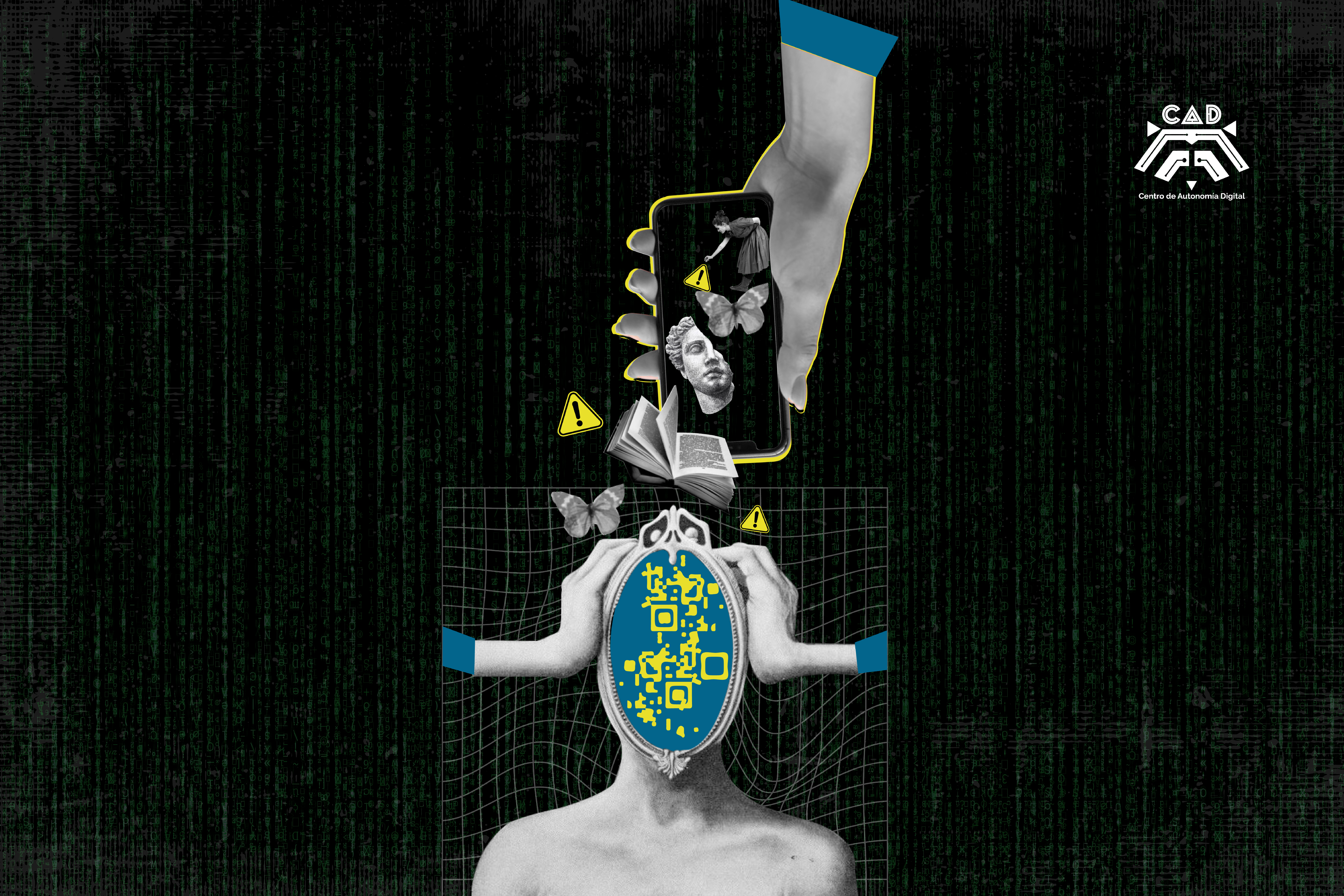
2025. The world isn’t spinning any faster, but we live as if it were. Everything is fleeting, fast, instantly. We’ve grown used to life happening in real time, without pause. We no longer perceive the feel of paper money or hear the clinking of coins when paying for a coffee. Today, a single scan is enough to access almost anything. Everything is literally at our fingertips.
QR, short for Quick Response, isn’t new. It was born in Japan in the 1990s as an evolution of the traditional barcode. Originally designed to track car parts, today it’s the gateway to the digital world: from restaurant menus to payment systems, social networks, surveys, promotions—even our medical information.
It seems harmless. Practical. Unstoppable.
And yet, this text, the least technical one from the Digital Autonomy Center, comes from a place of doubt, reflection, and maybe, just a touch of paranoia. It was inspired by “Plaything”, a chilling episode from season seven of Black Mirror, the interactive Netflix series, where a video game leads the player to create QR codes capable of manipulating human consciousness and life itself. A plot that weaves together programming, artificial intelligence, augmented reality, and yes, total control over perception, life, and decision making.
Fiction? Maybe not at all.
What’s behind a QR?
What looks like a simple pattern of squares and mini-mazes is, in reality, a complex system of encoded data. A QR can store URLs, passwords, geolocation, personal identifiers, and more. It can be read in milliseconds. And this is where another key technology comes in: your smartphone’s camera.
Modern devices are equipped with cameras that feature light, sensitive sensors and advanced digital image processing. These can detect and decode a QR code even in low light, from odd angles, or when partially obscured. Once scanned, your phone instantly translates the data into actions: opening a website, making a payment, sharing your location, or submitting your personal info into a database, all without explicitly asking you.
On the surface, it feels convenient. But underneath, it implies direct access to your personal information with just one click.
The problem isn’t the QR. It’s us.
The QR doesn’t think. It doesn’t decide. It simply obeys. But its widespread use has fostered a culture of mindless clicking, of accepting invisible terms and conditions, of giving away data without knowing to whom, for what purpose, or with what consequences.
Have you ever stopped to consider who creates the QR code you’re scanning? What information are you handing over? Who’s on the other end?
Many phishing campaigns, identity theft schemes, or digital surveillance tools hide behind malicious QR codes. Some can even alter your device’s behavior or install malware. But beyond the technical risk lies the human risk: the gradual loss of critical thinking in the face of technology, the normalization of surveillance, emotional and functional dependency.
So, where are we headed?
This isn’t about falling into techno-pessimism. When used responsibly, technology can transform lives. But as my sensei, Ola Bini says: “we’re not paranoid enough.” And maybe, we should be—just a little more.
QR scanners have taught us that convenience comes at a cost. One we don’t always pay with money, but with attention, autonomy, privacy, and even quality time with others. Sometimes, just lifting your phone to scan something makes you stop noticing what’s around you. Makes you less present.
Maybe it’s time to ask ourselves whether everything fast is necessarily good.
Using or not using QR codes isn’t just a technical decision. It’s a stance toward the world. A small act of rebellion in an environment where everything is designed to make you scan without thinking. Pausing to ask yourself twice before doing it might just be the first step towards a more conscious relationship with technology.